Korea's smallest firms lose workers 1.6x as fast as its largest. The pay ladder runs the other way.
Each month, small workplaces shed 4.29% of their enrolled workers; the biggest shed 2.66%. Hiring falls with size too. The firm that pays the most also holds onto people the longest.
AI-assisted, human-reviewed sourcing. Figures are pulled programmatically from the official sources listed at the end of this article and checked by an editor before publication.
labourfirm sizeturnovernational pensionmethodology
The Korean labour market’s most one-sided trade is small versus large. The big firm pays more and churns less. Nothing about that is balanced, and the pension register shows both halves of it in the same file.
Churn falls as firms grow
Divide each month’s lost pension members by enrolled members and you get a separation rate — how fast a workplace turns over. By size:
- 2–4 workers — 4.29% a month.
- 5–9 — 4.46% (the peak).
- 10–29 — 4.21%.
- 30–49 — 3.97%.
- 50–99 — 3.71%.
- 100–299 — 3.26%.
- 300–999 — 2.95%.
- 1,000+ — 2.66%.
The smallest firms lose workers about 1.6 times as fast as the largest. The gradient is not perfectly smooth — churn actually peaks in the 5–9 band before falling — but from there down the size ladder it drops at every step. Big firms hold people; small firms cycle them.
Hiring tells the same story from the other side: the smallest firms enrol new members at 5.26% a month, the largest at 2.50%. Small workplaces are busier at both doors — more people in, more people out — because that is what a small, less permanent payroll looks like.
The two ladders point the same way
Read this against the companion cut on pay and the asymmetry is stark. The national-pension bill per worker — our pay proxy, capped at the pension ceiling — rises with size, from 291,760 won at the smallest firms to 456,315 at the largest. The churn ladder falls with size. So the large Korean firm wins on both counts at once: it pays more and it keeps you longer. There is no size band where you trade one for the other.
That is the economic engine behind Korea’s fixation on the big-company job. It is not one advantage, it is two, stacked — and the small firm has no offsetting edge in this data to put against them.
What this rate is, and isn’t
A separation here is a member leaving a workplace’s enrolment. It does not say why. A worker who quit for a better job at a larger firm counts as a separation at the small one and a hire at the large one — which means some of what looks like small-firm instability is really the pipeline feeding the big firms. That reading is consistent with the numbers but not proven by them. What the numbers prove is the pattern: attachment to the payroll strengthens, monotonically enough, as the payroll grows.
What we did not claim
We have not seasonally adjusted, and June is one month. We have not separated voluntary from involuntary exits, because the register cannot. And we have not controlled for industry — construction, which is small-firm-heavy, churns for reasons of its own that the companion industry cut takes up. The size gradient survives all of that as a raw fact; the causes behind it are a longer argument.
Data & Verification Notes
- Data as of
- Sources
- National Pension Service (Republic of Korea) — National Pension enrolled-workplace register — monthly bulk file (2026-06)
- Cross-checks
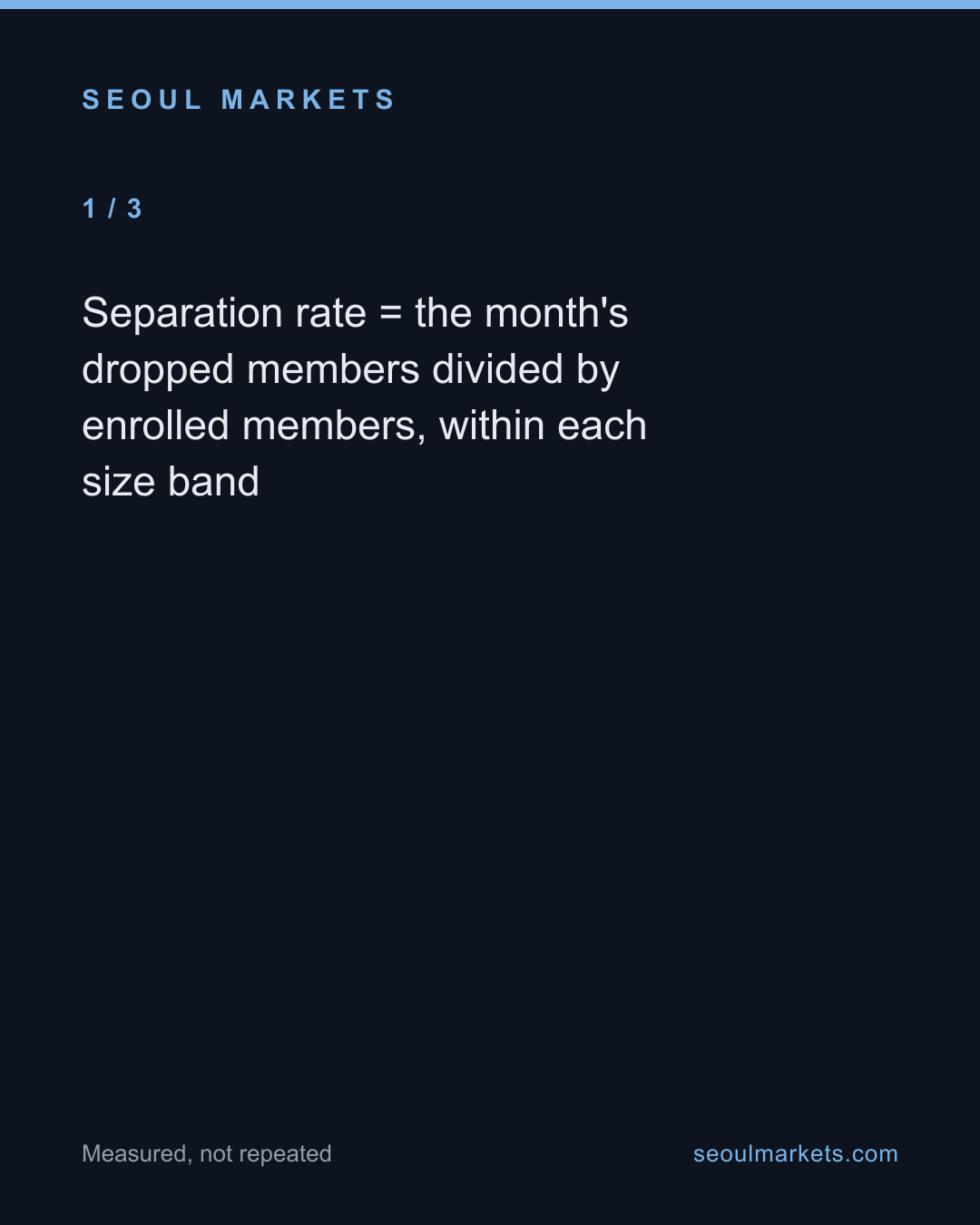
- Separation rate = the month's dropped members divided by enrolled members, within each size band
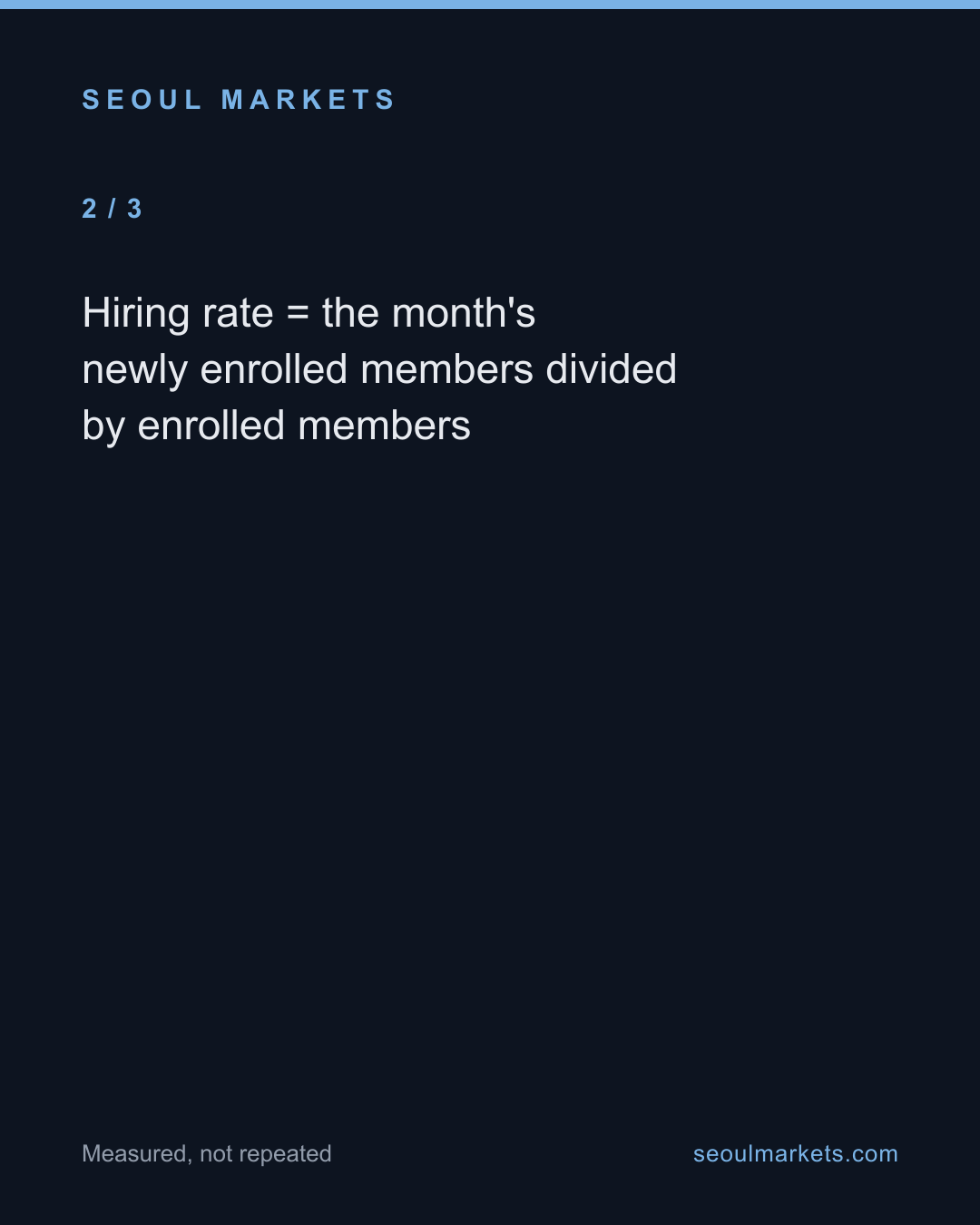
- Hiring rate = the month's newly enrolled members divided by enrolled members
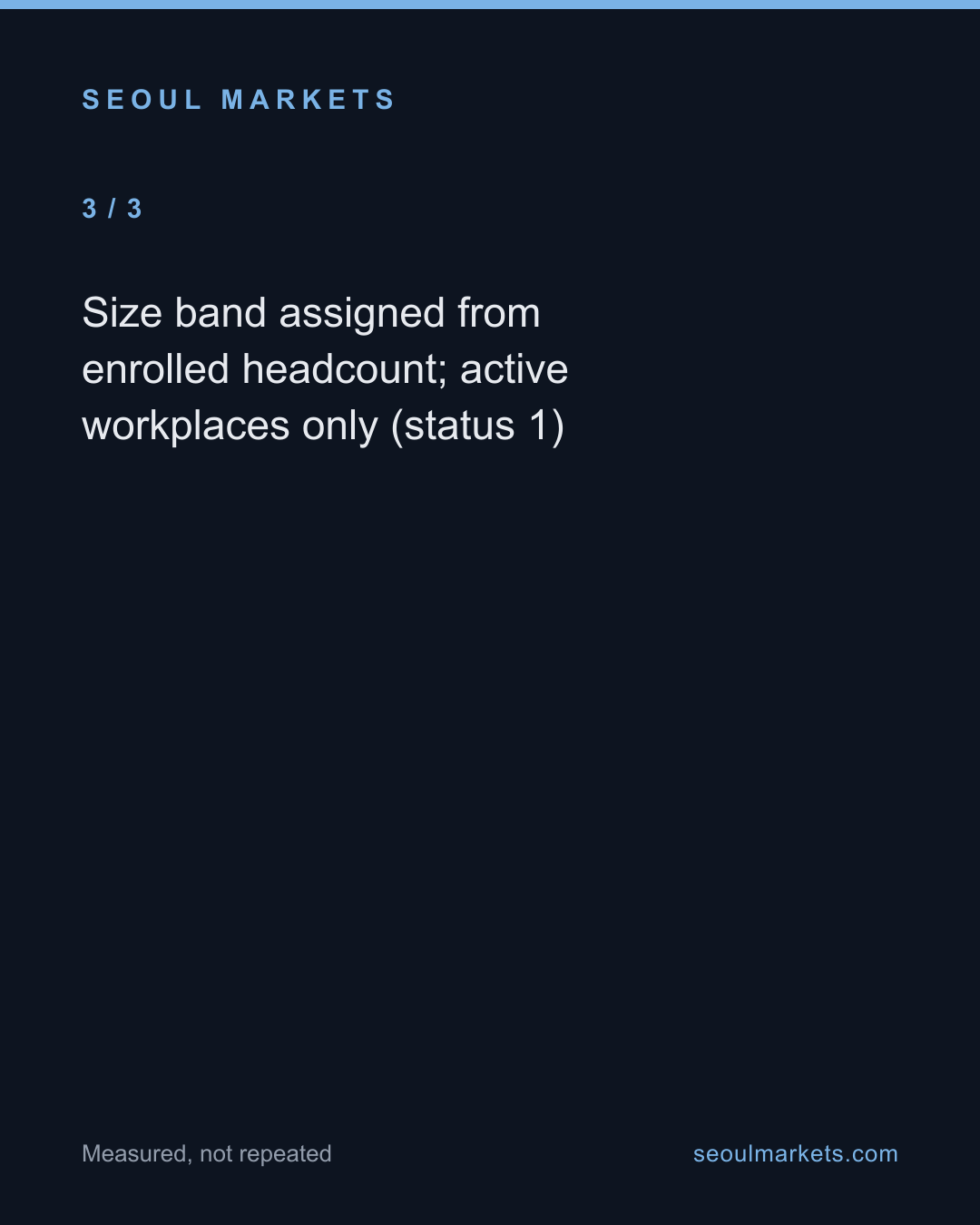
- Size band assigned from enrolled headcount; active workplaces only (status 1)
- Excluded figures
- The reason a worker left — the register records the exit, not whether it was a quit, a layoff, a retirement, or a move
- Job-to-job moves — a worker leaving a small firm for a large one shows as a separation in one and a hire in the other
The full dataset behind these figures — every listed company, every row — is available to license. SeoulMarkets data for licence →
Not investment advice. SMarkets publishes data journalism for general information only. Nothing here is investment advice, a recommendation, or an offer to buy or sell any security — any investment you make is at your own risk and responsibility. Figures are derived from official public data sources and may be revised by the issuing agency. Verify independently before acting.
Take this away — 5 cards
The figures in this article, as images. Free to repost with the address on them.