Korea's import prices rose 9% in the seller's currency and 20% in won. The gap is the exchange rate.
Priced in the currency each contract is written in, Korea's imports cost 9.1% more over the year to June. In won they cost 19.7% more. The 33-point gap between the two indices is not the goods getting dearer — it is the won getting weaker.
AI-assisted, human-reviewed sourcing. Figures are pulled programmatically from the official sources listed at the end of this article and checked by an editor before publication.
import pricesinflationwonexchange ratekorea
There are two ways to say how much more Korea paid for its imports this year, and they disagree by more than double.
Measured in the currency each contract was written in — the dollars, yen and euros the sellers actually quoted — the price of Korea’s imports rose 9.1% over the year to June 2026. Measured in won, the currency Korean importers actually pay in, it rose 19.7%. Same goods, same year, same statistics office. The difference between the two numbers is not the goods. It is the won.
The basket, priced three ways
The Bank of Korea publishes its import price index on a 2020 = 100 base, and it publishes it three times over — in the contract currency, in dollars, and in won. Lined up, the gap is the whole story.
| Import price index (2020 = 100) | Jul 2025 | Jun 2026 | Change |
|---|---|---|---|
| Contract currency | 117.97 | 128.76 | +9.1% |
| US dollar | 115.63 | 124.58 | +7.7% |
| Won | 134.84 | 161.34 | +19.7% |
By June the won index sat at 161.3 against a contract-currency index of 128.8 — a gap of 32.6 points. In plain terms, the identical basket of imports cost 25.3% more once it was converted into won than it did in the money it was priced in. More than half of the rise Korean buyers felt was the exchange rate doing the work, not the world getting more expensive.
What went up, and what quietly fell
Underneath the average, the basket split in two.
The things that rose hardest in won are the things Korea cannot make for itself. Jet fuel stands at 374 on the 2020 base, diesel at 344, and refined metals — aluminium at 292, copper at 280 — not far behind. These are the energy-and-materials imports that also drive Korea’s largest trade deficits, and a weak won makes every shipment of them dearer twice over.
At the other end, the imports that got cheaper in won are electronics: televisions at 53, audio-visual gear at 76, display-making machinery at 85 — all well below their 2020 level. The category Korea is famous for exporting is one where imported prices have fallen even through a weak-won year, because the underlying products keep deflating faster than the currency can drag them up.
Why it matters which number you quote
An importer who reads the contract-currency index sees a 9% year and thinks the world repriced modestly. The importer who pays the bill lives in the 20% year. Both indices are correct; they measure different things, and the space between them is a running tally of what the currency added. For a country that buys its energy and much of its machinery from abroad, that space is not a rounding error — this year it was more than half of the whole increase.
Data & Verification Notes
- Data as of
- Sources
- Statistics Korea — KOSIS (Bank of Korea data) — Import Price Index (수입물가지수) by basic groups, table DT_401Y015
- Cross-checks
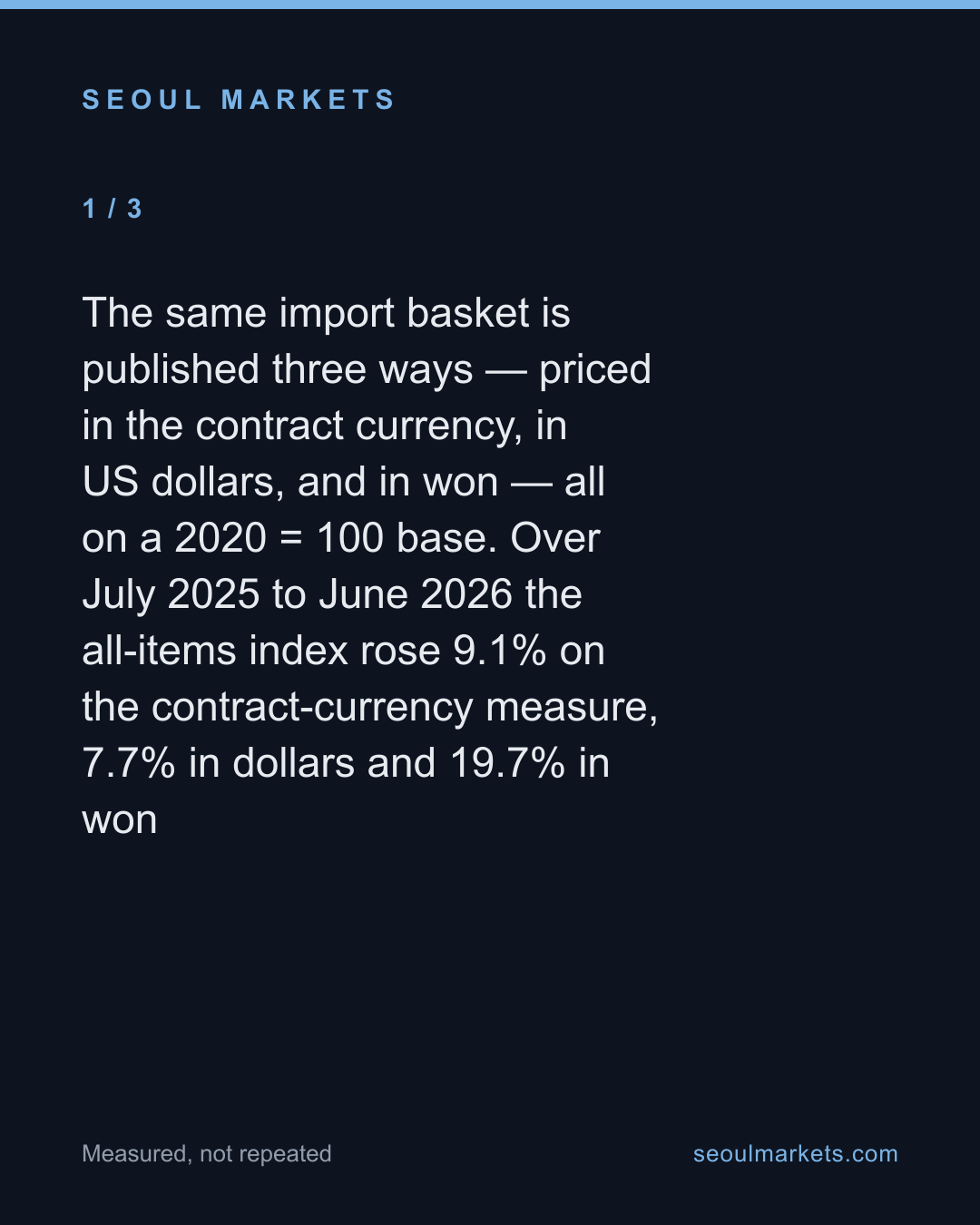
- The same import basket is published three ways — priced in the contract currency, in US dollars, and in won — all on a 2020 = 100 base. Over July 2025 to June 2026 the all-items index rose 9.1% on the contract-currency measure, 7.7% in dollars and 19.7% in won
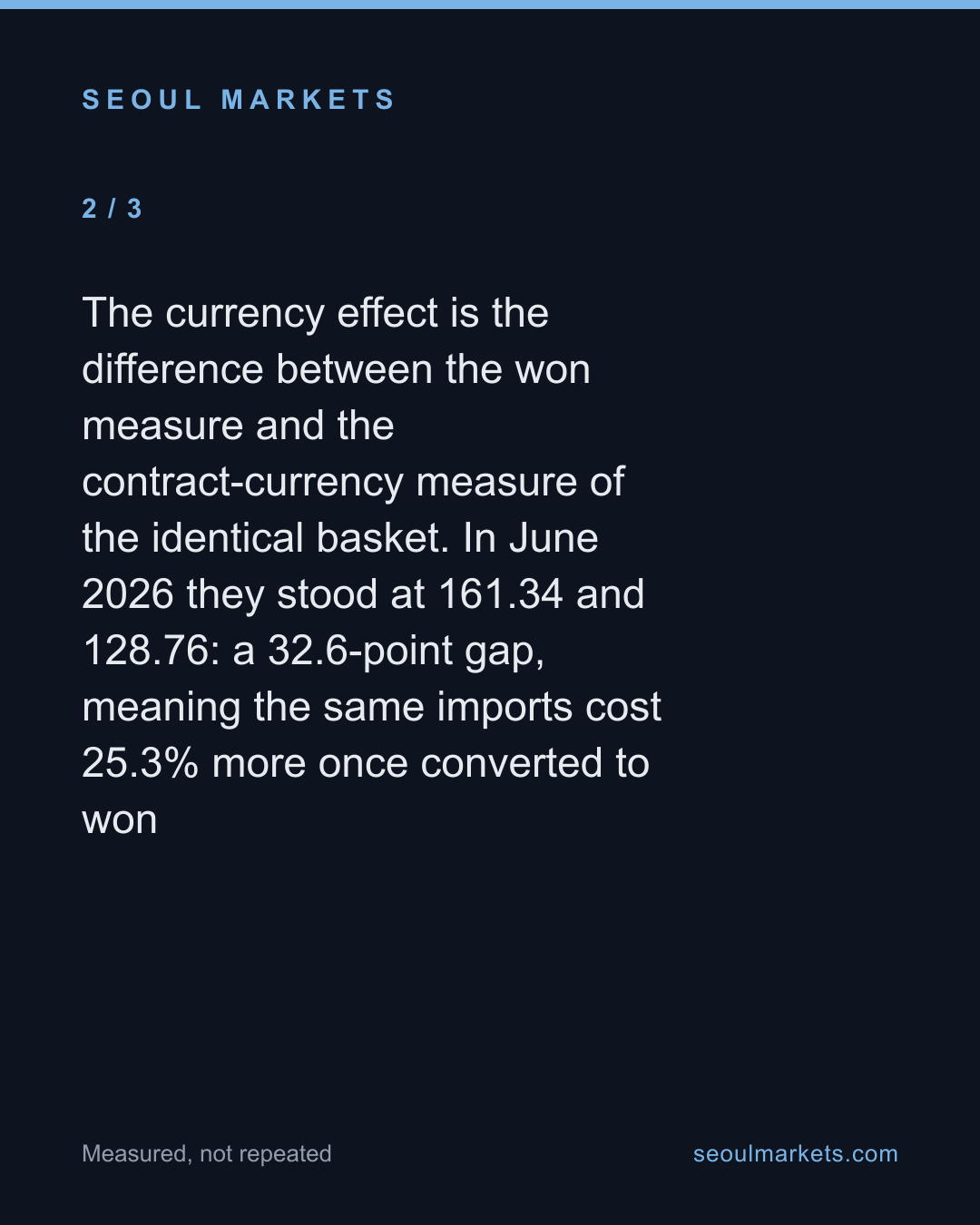
- The currency effect is the difference between the won measure and the contract-currency measure of the identical basket. In June 2026 they stood at 161.34 and 128.76: a 32.6-point gap, meaning the same imports cost 25.3% more once converted to won
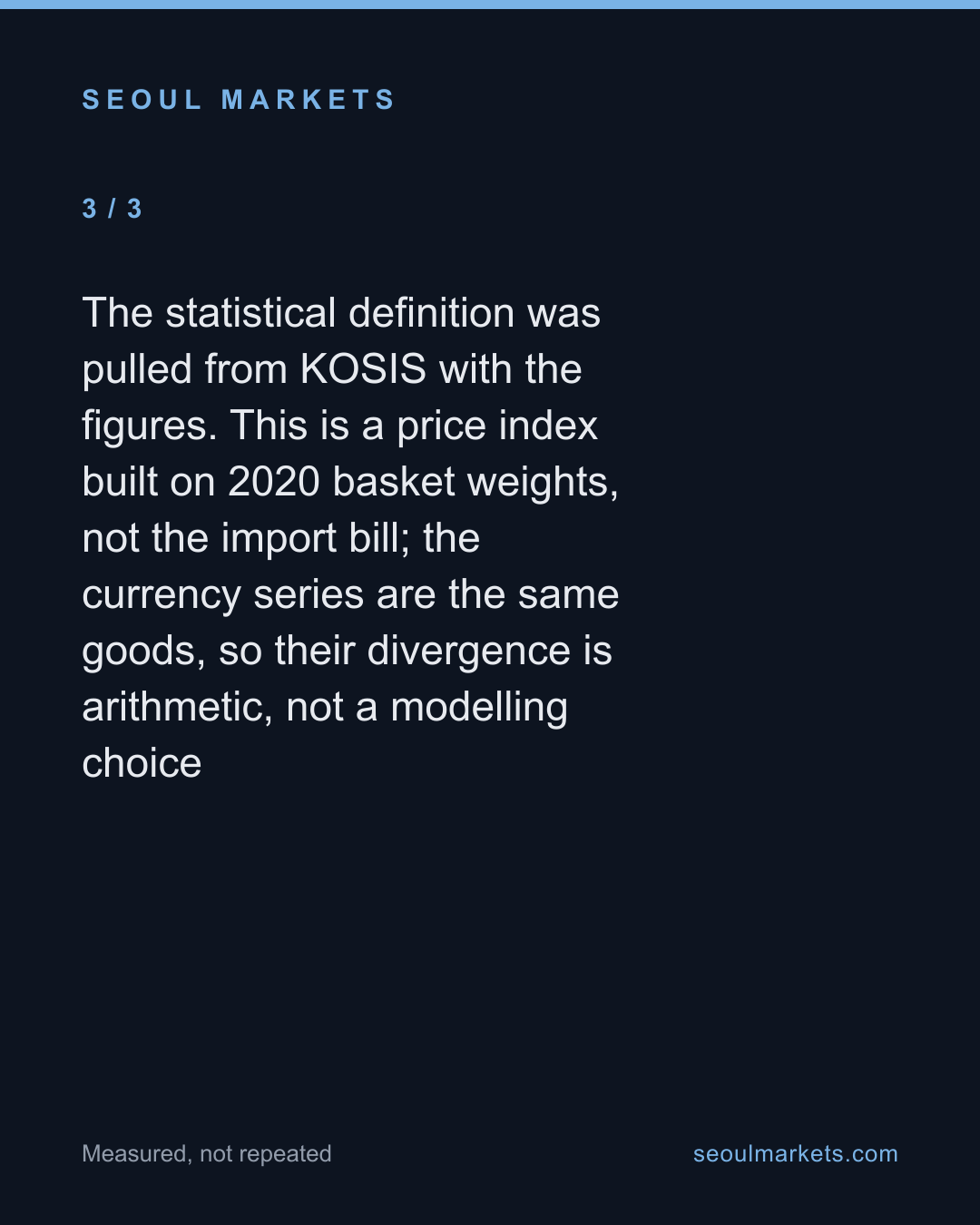
- The statistical definition was pulled from KOSIS with the figures. This is a price index built on 2020 basket weights, not the import bill; the currency series are the same goods, so their divergence is arithmetic, not a modelling choice
- Excluded figures
- Volumes and the total import bill. This is a price index. If Korea bought fewer barrels, the money spent could fall even as this index rises
- Which currencies contracts are actually written in. KOSIS reports a 'contract currency' basket but not the currency mix; the dollar series is provided separately and rose 7.7%, close to the contract-currency figure
- The 2020 basket weights. Trade has shifted since; a fixed-weight index understates goods that grew as a share of imports and overstates those that shrank
- Why the won weakened. The data measures the size of the currency effect on import prices, not its cause
The full dataset behind these figures — every listed company, every row — is available to license. SeoulMarkets data for licence →
Not investment advice. SMarkets publishes data journalism for general information only. Nothing here is investment advice, a recommendation, or an offer to buy or sell any security — any investment you make is at your own risk and responsibility. Figures are derived from official public data sources and may be revised by the issuing agency. Verify independently before acting.
Take this away — 5 cards
The figures in this article, as images. Free to repost with the address on them.