Korea has 183,351 registered funds, and the factory that makes them is slowing down.
New fund registrations peaked in 2020 near 6,000 a year and have roughly halved since. What Korea launches is mostly derivatives and bonds — equity funds are one in ten. Among funds that name a country, America outnumbers China two to one.
AI-assisted, human-reviewed sourcing. Figures are pulled programmatically from the official sources listed at the end of this article and checked by an editor before publication.
fundsasset managementfund launcheskorea
Korea’s fund registry lists 183,351 funds. That number is less impressive than it looks — much of it is the same fund registered several times for its different share classes, and codes for funds long closed are never cleanly retired. But one thing the registry does record honestly is when each fund was set up, and read that way it shows an industry that has stopped multiplying the way it used to.
The launch curve has rolled over
| Funds established | Count |
|---|---|
| 2020 | 5,990 |
| 2021 | 4,060 |
| 2022 | 3,285 |
| 2023 | 3,197 |
| 2024 | 2,312 |
| 2025 | 2,698 |
New registrations peaked in 2020 near 6,000 and have run at roughly half that since. Some of that is share classes no longer being spun up as freely; some is genuinely fewer new products. Either way the direction is clear — the years when Korean asset managers launched a new fund every ninety minutes are behind them.
What actually gets launched
Ask what a Korean fund is and the intuitive answer — a stock fund — is the wrong one. By count, the register is dominated by derivatives and bonds.
| Type | Funds |
|---|---|
| Derivatives | 49,114 |
| Bond | 47,606 |
| Mixed-bond | 32,235 |
| Equity | 18,366 |
| Fund-of-funds | 13,956 |
Equity funds are just one in ten. The bulk of what the industry registers is fixed income and structured product — the plumbing of yield and hedging, not the stock-picking that gets the coverage.
Where the themed money points
Most funds carry no theme at all; 108,496 of the 183,351 leave the field blank. Of those that do name something, the pattern is a map of where Korean savers look outward — and it points at America.
- United States: 8,500 funds
- China: 3,202
- Japan: 864
- ESG: 949
- AI and robotics: 459
- Semiconductors: 133
The US-themed count is more than double China’s and nearly ten times Japan’s. And the themes that dominate the financial press — AI, robots, semiconductors, ESG — are, in the register, a rounding error next to a plain American index fund. What the industry talks about and what it actually stamps a code on are not the same list.
Related — where this shows up
- 183,351 funds isn’t 183,351 choices — a big count is not a wide menu.
Data & Verification Notes
- Data as of
- Sources
- Korea Financial Investment Association (KOFIA) — fund standard-code registry — Registered fund master (표준코드·유형·주제·설정일), 183,351 funds
- Cross-checks
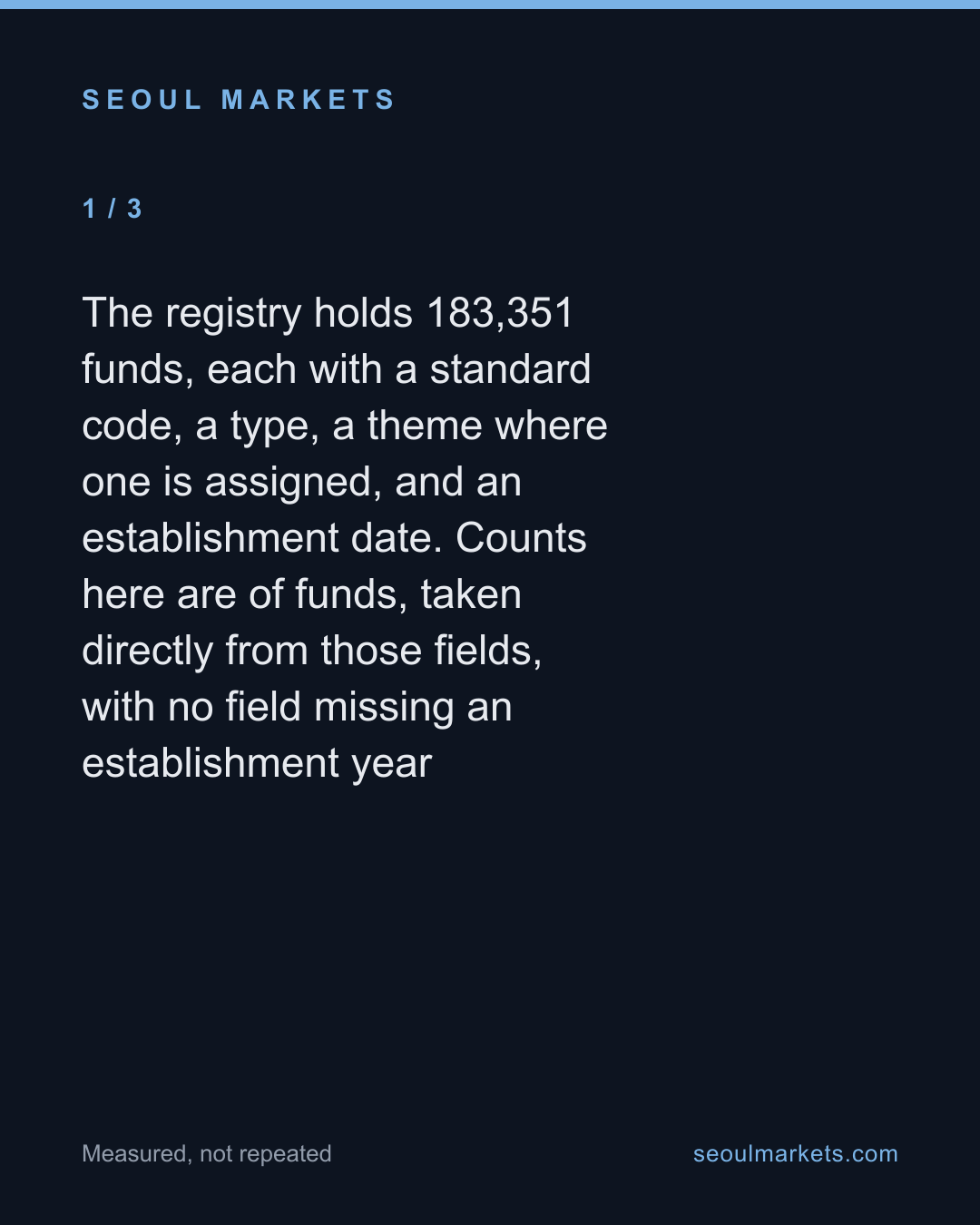
- The registry holds 183,351 funds, each with a standard code, a type, a theme where one is assigned, and an establishment date. Counts here are of funds, taken directly from those fields, with no field missing an establishment year
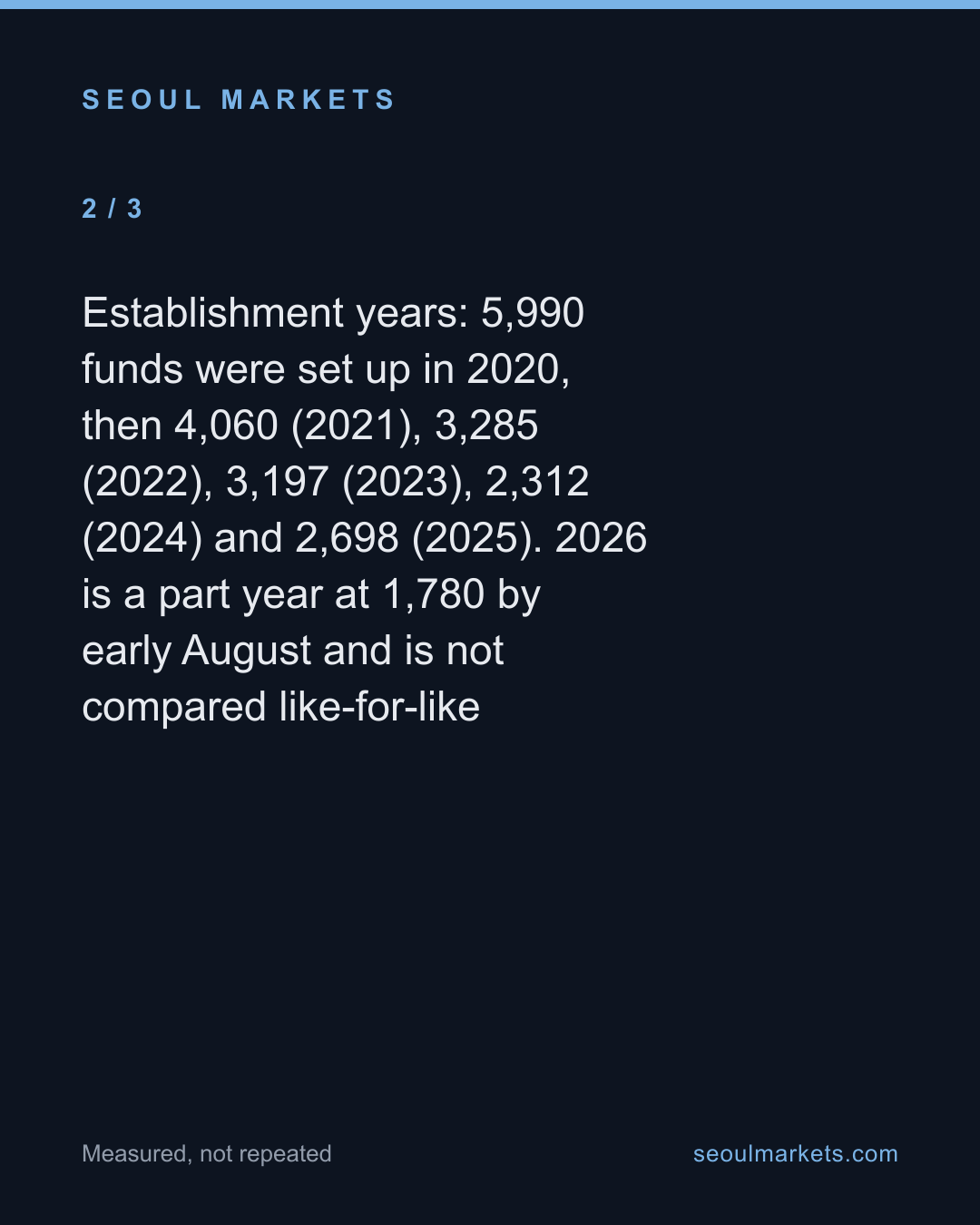
- Establishment years: 5,990 funds were set up in 2020, then 4,060 (2021), 3,285 (2022), 3,197 (2023), 2,312 (2024) and 2,698 (2025). 2026 is a part year at 1,780 by early August and is not compared like-for-like
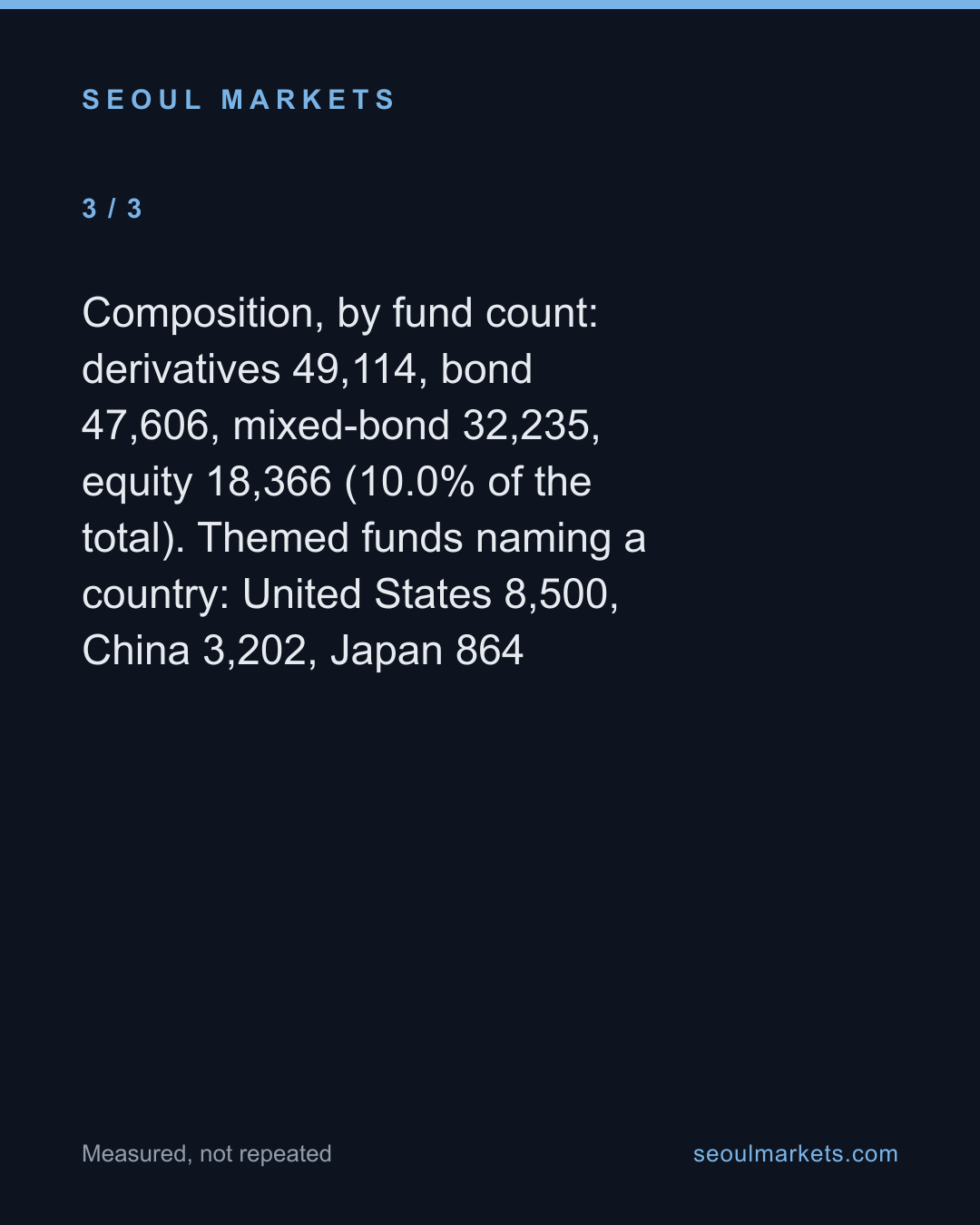
- Composition, by fund count: derivatives 49,114, bond 47,606, mixed-bond 32,235, equity 18,366 (10.0% of the total). Themed funds naming a country: United States 8,500, China 3,202, Japan 864
- Excluded figures
- Assets. This is a count of registered funds, not money. A registry weighs a ₩1bn fund and a ₩1tn fund the same, so none of these figures says where Korean savings actually sit — only what got registered
- Share classes. The same fund is registered several times over for its retail, fee-based and hedged classes, each with its own code and establishment date. The 183,351 count and the yearly launch counts are inflated by this, in a way the registry does not let us net out
- Closed and merged funds. A standard code is not retired cleanly, so the registry carries funds that no longer take money. The stock is a cumulative record, not a live one
- Returns, holdings and fees. The registry names funds and dates them; it does not say what they own or how they did
The full dataset behind these figures — every listed company, every row — is available to license. SeoulMarkets data for licence →
Not investment advice. SMarkets publishes data journalism for general information only. Nothing here is investment advice, a recommendation, or an offer to buy or sell any security — any investment you make is at your own risk and responsibility. Figures are derived from official public data sources and may be revised by the issuing agency. Verify independently before acting.
Take this away — 5 cards
The figures in this article, as images. Free to repost with the address on them.